How to Ask for a Testimonial: When, Where and What to Say (With Templates)
1 November 2026
A practical guide to asking customers and clients for testimonials: the right moment, the right channel, word-for-word messages for email, WhatsApp and in person, and how to follow up without being pushy.
Most testimonials never get written for one simple reason: nobody asked, or the ask came at the wrong time, in the wrong place, with too much work attached. Happy customers are usually glad to help. The job is to make saying yes take two minutes.
This guide covers the whole process, from picking the moment to following up, with messages you can copy. It's the foundation for everything else we write about collecting praise.
The short version
- Ask within a day or two of a good moment, not on a schedule.
- Ask one person at a time, in the channel you already talk to them on.
- Name the specific thing they were happy about, so they know what to write.
- Say how short it is and give one link, not an attachment or a reply-to-this-email.
- Give two or three questions to answer, so nobody faces a blank box.
- Follow up once, then stop.
- Get permission to publish, and never change what they meant.
1. Pick the moment, not the date
The best testimonial requests are triggered by something that happened, not by a calendar. When a customer has just seen a result, the words come easily and they're specific. A month later you get "Great service, would recommend."
Good moments to ask:
- They told you they're happy. A thank-you email, a kind message, a five-star rating. This is the strongest signal there is: reply, thank them, and ask in the same breath.
- A project or delivery is done. An agency at handover, a contractor at the final walkthrough, a coach after the last session.
- They hit a milestone. For software, that's often a week or two in, once they've used the product enough to have an opinion, or right after they reach a goal inside it.
- A problem was solved. A support ticket closed well is a moment of real gratitude, and the person remembers exactly what you did.
Bad moments: the day they sign up, in the middle of a problem, or alongside an invoice.
2. Ask the right people
Start with the customers who already said something nice. They're the most likely to say yes, and they've practically written the testimonial already.
Don't ask in bulk. A newsletter blast that says "leave us a testimonial!" gets almost nothing back, because nobody feels personally asked. One message to one person, with their name and their result in it, gets answered.
Don't ask someone who's unhappy for a public testimonial. Ask what went wrong instead, privately. It's better for them and for you.
3. Ask where they already talk to you
The channel matters more than most people think. If a customer talks to you on WhatsApp, an email request feels like a form letter from a stranger. If they only ever email you, a text out of nowhere feels odd.
| If you usually talk… | Ask… |
|---|---|
| By email | In a reply to their last email, not a new templated one |
| On WhatsApp, Messenger or SMS | In the chat, with a short message and a link |
| In person | Out loud, then send the link the same day, or show a QR code |
| Inside your product | With an in-app prompt at the milestone, then a follow-up email |
Whatever the channel, the person should be able to answer on their phone in two minutes, without creating an account or downloading anything.
4. What to say
A good request has five parts, and fits on a phone screen:
- Their name and the specific moment: "Thanks again for Friday."
- Why it matters to you: "It really helps people who are where you were."
- How short it is: "Two questions, about two minutes."
- One link.
- An easy way out: "No worries if you're busy."
Email template
Subject: A quick favour?
Hi Priya,
Thanks again for the kind words after the launch, it was a pleasure working on it with your team.
Would you put that into a few words we could share on our website? It helps other teams see what working with us is like. It's two short questions and takes about two minutes:
[Share your experience]
No worries at all if you're busy.
Thanks, Maya
WhatsApp or SMS template
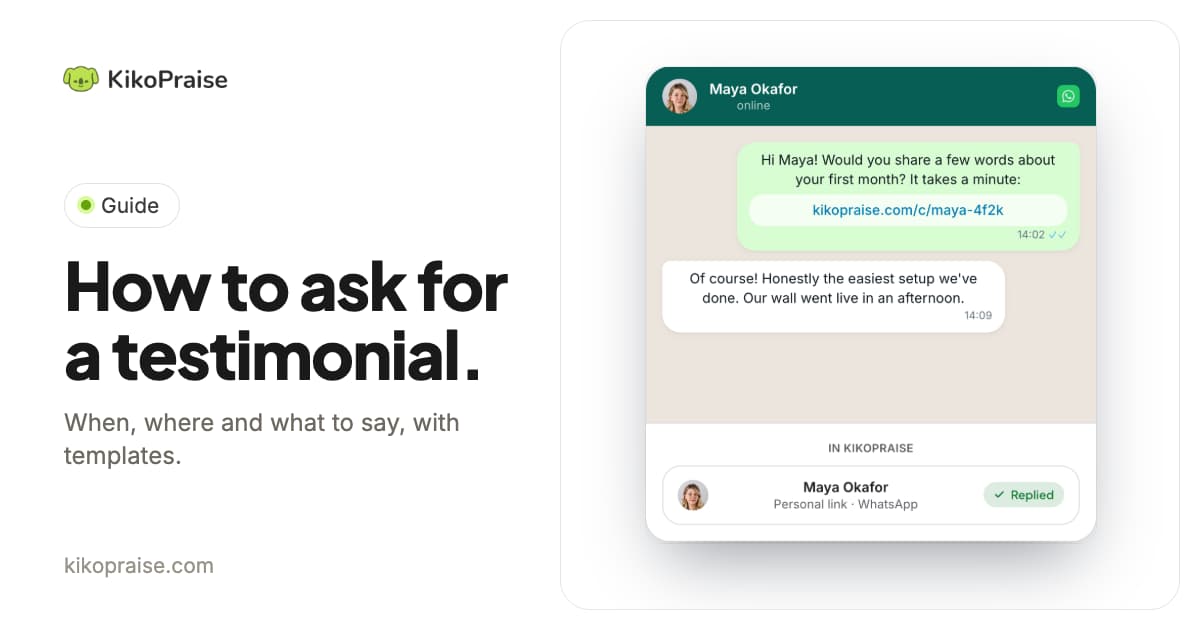
Hi Dan! Thanks again for Friday, so glad the new site is already bringing in orders. Would you mind putting that in a few words for our website? Two questions, two minutes: [link]
No pressure at all 🙂
Keep chat messages shorter than email. No subject, no sign-off, one link.
In person
"I'm really glad this worked out. Would you mind if I sent you a short link to say that in a couple of sentences? It helps us more than you'd think."
Then send the link the same day, while they remember saying yes.
5. Make it easy to answer
A blank text box is the hardest thing to fill in. Give people two or three questions, and they'll write something specific without trying.
Questions that get useful answers:
- What was going on before you came to us?
- What made you choose us?
- What's different now? A number, if you have one.
- What would you tell a friend who's thinking about it?
Ask for a star rating if it's useful to you, and let people choose between writing a few lines and recording a short video. Some people would much rather talk for thirty seconds than write a paragraph.
Ask for what makes a testimonial believable: their name, and their role and company if it's a business. A photo helps. Make everything beyond the name optional, so it never feels like a form.
6. Follow up once
People mean to reply and then forget. One reminder, three to five days later, is a kindness:
Hi Dan, just bumping this in case it got buried. Here's the link again: [link]. Totally fine if now's not a good time!
If there's still no reply after that, let it go. Two unanswered reminders cost you more goodwill than the testimonial is worth.
7. Get permission, and keep it honest
Before you publish, make sure the customer agreed to it being shared publicly, with their name. A checkbox on the form is enough.
On editing, the rule of thumb is simple: fix typos and trim for length, but never change what they meant. In the US, the FTC's Endorsement Guides say an endorsement must reflect the honest opinion of the endorser. If you've edited more than a typo, send them the new version and ask if it still says what they meant.
On rewards: in the US, offering something only to people who leave a positive testimonial is banned under the FTC's 2024 rule on fake reviews and testimonials. A small thank-you that doesn't depend on what they say is allowed, but should be disclosed where the testimonial appears. This isn't legal advice, and other countries have their own rules, so check where you sell.
Mistakes that cost you testimonials
- Asking too late. The best time was the day they were happy.
- Asking everyone at once. Personal requests get answered; broadcasts get ignored.
- Making it a chore. Logins, long forms and "reply to this email with a paragraph" all kill replies.
- Asking for a "testimonial" with no guidance. Questions get specifics; blank boxes get "great service".
- Chasing more than once.
- Publishing without asking. Even a glowing private message needs permission before it goes on your website.
Doing this with KikoPraise
This is our product, so take this section as a description rather than advice.
KikoPraise is built around this process. Each request is a personal link you can send by email from the dashboard, or paste into WhatsApp, Messenger or SMS. The Requests page shows whether each person opened it and whether they replied, so you know who to remind, once. The form shows your guided questions and takes text or video in the browser, with no app or account.
Everything arrives as Pending, so you can fix a typo and approve it before it appears anywhere. The free plan includes 20 tracked email requests a month, and links you paste into a chat are unlimited on every plan. See how WhatsApp testimonials work or pricing.
Ask, approve, show. In one place.
Personal links for email and WhatsApp, nothing public until you approve it, and a widget for your site. Free plan, no card.
Start collecting free